Why HVAC Companies Leak Profits Without Knowing It
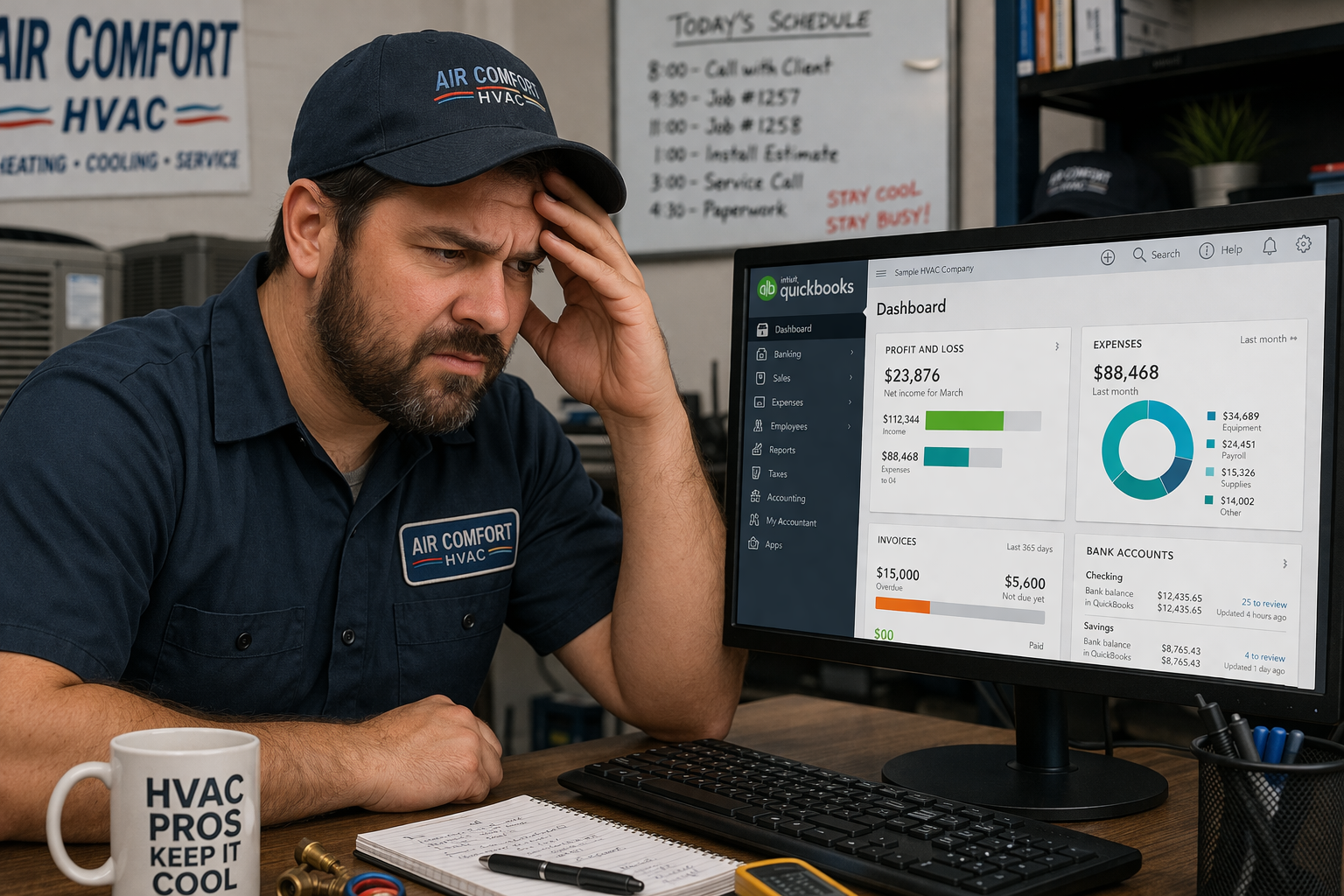
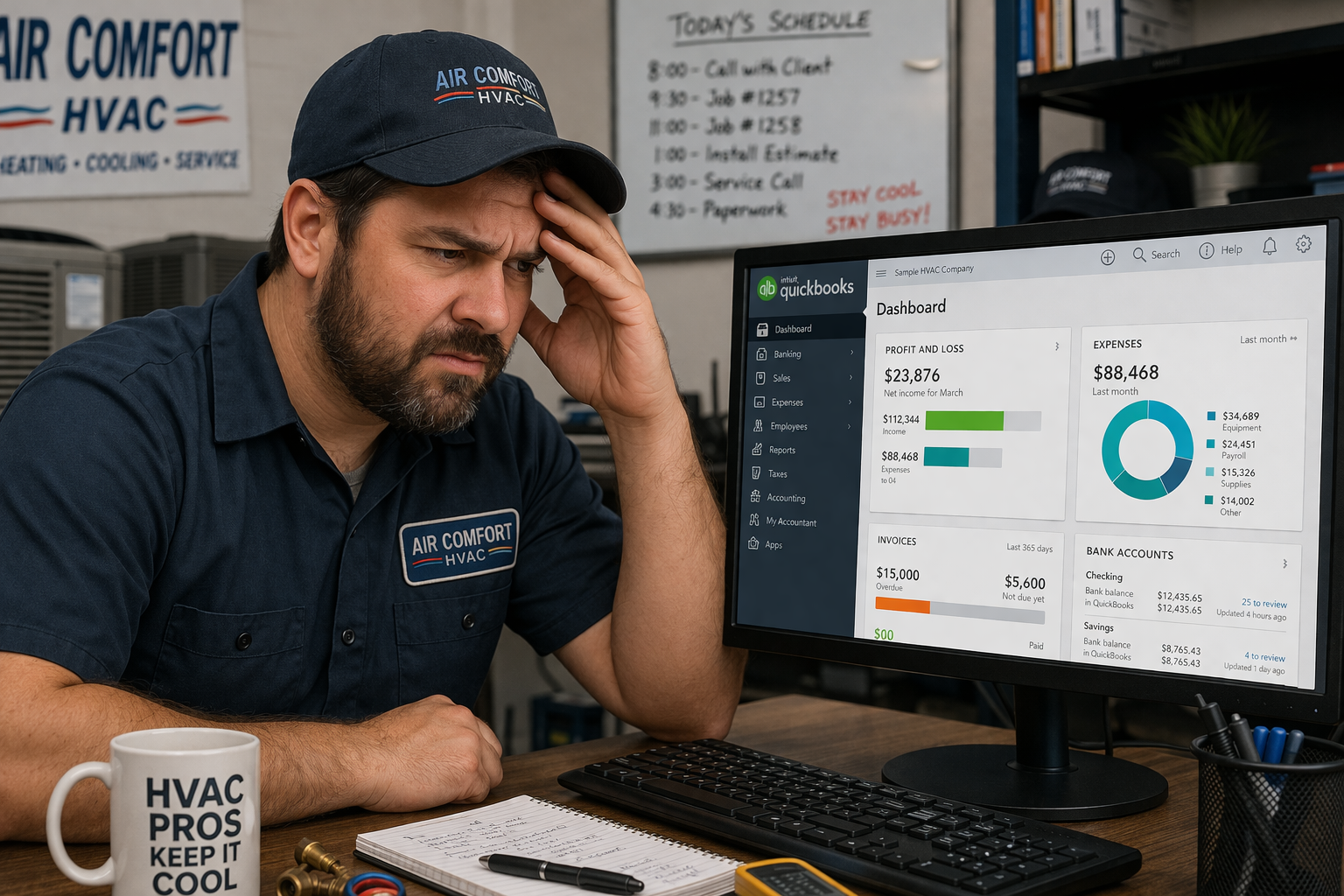
Picture this: Your HVAC business had a record-breaking year. Revenue is up. The trucks are busy. The phone keeps ringing. But at the end of the quarter, you check your bank account and wonder — where did all the money go?
This scenario is far more common than most HVAC business owners admit. The HVAC industry is one of the most operationally complex in the trades, with thin windows for error at every stage — from job costing and labor scheduling to parts procurement and invoicing. Without a disciplined financial process, profits slip through the cracks silently and steadily.
An HVAC Profit Leak Audit is a structured financial review that identifies exactly where revenue is escaping from your business — before it becomes a crisis. Think of it less like an accounting exercise and more like putting thermal imaging on your own finances. The leaks become visible. You fix them. Your margins grow.
In this guide, we'll walk you through real benchmarks for HVAC industry profit margins, the formulas that matter most, the eight most common profit drains, and a practical step-by-step audit you can begin today.
"The most dangerous leaks in an HVAC business are the ones that don't set off any alarms — they're slow, they're systemic, and by the time you notice them, they've already cost you tens of thousands."
HVAC Industry Profit Margins: What the Numbers Actually Look Like
Before you can audit your own margins, you need a clear picture of what healthy HVAC profit margins look like across the industry. The numbers vary depending on business size, service mix (residential vs. commercial), and geography — but the benchmarks below give you a solid reference point.
📊 HVAC Business Profit Margins by Service Type
| Business Size | Avg. Revenue | Typical Net Margin | Industry Rating |
|---|---|---|---|
| Solo Operator (1–2 techs) | $150K–$500K | 18–30% | Strong |
| Small Company (3–10 techs) | $500K–$2M | 10–22% | Moderate |
| Mid-Size (10–25 techs) | $2M–$7M | 8–18% | Moderate |
| Large Operation (25+ techs) | $7M+ | 5–15% | Thin — needs active management |
Notice that HVAC business profit margins tend to compress as companies grow. This is because larger operations carry significantly higher overhead — fleet costs, dispatchers, office staff, insurance — without always having pricing structures that account for it. This is where a profit leak audit becomes critical at scale.
HVAC Profit Margin Formulas You Must Know
Building a reliable HVAC profit margin calculator starts with understanding the right formulas. These aren't just accounting exercises — they're the diagnostic tools that tell you whether your business is truly healthy or just busy.
Formula 1: Gross Profit Margin
Your gross profit margin reveals how efficiently you're turning revenue into profit after covering the direct costs of delivering your service.
Gross Profit Margin Formula
📌 COGS for HVAC includes direct labor wages, subcontractors, parts, equipment, and job-specific materials.
Formula 2: Net Profit Margin
Net profit margin is the bottom line — what's actually left after every expense, including overhead, admin, marketing, insurance, and debt service.
Net Profit Margin Formula
📌 Operating expenses include rent, utilities, vehicle costs, software, payroll taxes, marketing, and administrative salaries.
Formula 3: Labor Cost Ratio
In HVAC, labor is typically your single largest cost driver. Your labor cost ratio shows whether your pricing is keeping up with what you're paying your technicians.
Labor Cost Ratio Formula
📌 If your labor ratio exceeds 38–40%, your pricing likely isn't accounting for true labor burden (taxes, benefits, downtime).
Formula 4: Break-Even Point
Every HVAC business owner should know the exact revenue number at which they cover all costs. Below this number, every job generates a loss.
Break-Even Point Formula
📌 If your monthly revenue consistently falls below your break-even point, no amount of hustle will fix the problem — only better pricing and margin management will.
Run all four formulas monthly — not just at year-end. HVAC businesses are highly seasonal, and a single slow quarter can skew your annual picture significantly. Monthly visibility is the difference between reacting and predicting.
The 8 Biggest HVAC Profit Leaks (And How to Spot Them)
A profit leak is any systemic inefficiency, pricing gap, or operational failure that consistently reduces the margin on your work — often without any single transaction looking alarming. Here are the eight most common leaks AcctSage identifies when auditing HVAC businesses:
-
1. Underpriced Service Calls
Many HVAC companies price service calls based on what competitors charge, not on what their actual labor burden costs. If you haven't recalculated your fully-loaded hourly rate in the past 12 months, you're almost certainly underpricing. Factor in: base wage + payroll taxes + benefits + downtime + vehicle cost + insurance = your true technician cost.
-
2. Poor Parts & Materials Management
Technicians buying parts at retail, excessive stock in vans that rarely gets used, or failing to mark up materials adequately — these all erode gross margin. Best practice: establish a standard parts markup of 25–50% and audit inventory quarterly.
-
3. Unbillable Time Leakage
Travel time between jobs, return trips for forgotten parts, warranty callbacks that could have been avoided — every hour a technician is on the clock but not billing a client is a profit leak. Track billable vs. total hours weekly.
-
4. Invoicing Errors & Delays
Jobs that are completed but invoiced late — or not invoiced at all due to workflow gaps — are pure revenue loss. In HVAC, it's surprisingly common for 3–7% of completed work to go unbilled. A weekly invoice reconciliation can recover significant revenue.
-
5. Callbacks & Rework Costs
Every callback represents a double labor cost: you paid to do the job once and then paid again to redo it. High callback rates are often a symptom of rushed work or inadequate quality control. Track callback rates by technician and address outliers directly.
-
6. Fleet & Fuel Inefficiency
Unoptimized routing, idle vehicles, personal use of company trucks, and deferred maintenance all compound fleet costs. For multi-truck operations, fleet costs can represent 8–14% of revenue. Use GPS dispatch software and enforce a fleet usage policy.
-
7. Missing Maintenance Agreement Revenue
Maintenance plans are the highest-margin revenue stream in HVAC. Yet many companies sell them inconsistently or fail to systemize renewals. If fewer than 20% of your active clients are on a maintenance agreement, you have a significant revenue and margin opportunity sitting untouched.
-
8. No Real-Time Financial Visibility
Reviewing financials quarterly — or only at tax time — means problems compound for months before anyone catches them. Without monthly P&L reviews broken down by service line, you're flying blind. This alone is often the root cause that allows every other leak on this list to persist.
How to Run Your Own HVAC Profit Leak Audit in 5 Steps
An HVAC Profit Leak Audit doesn't require a financial degree — but it does require honesty, good data, and consistent execution. Here's a five-step framework you can apply to your business right now.
Pull Your P&L by Service Line
Don't look at your business as one lump sum. Break your revenue and costs into at least three buckets: service & repair, new installations, and maintenance agreements. Each segment should have its own gross margin. If you can't see this breakdown, your bookkeeping isn't set up correctly — that's the first thing to fix.
Calculate Your True Fully-Loaded Technician Cost
Take a technician's base annual salary, add payroll taxes (7.65%), workers' comp, health benefits, paid time off, vehicle costs, tools, and uniform costs. Divide by billable hours (not total hours). This is your real cost per billable hour. Compare it to what you're actually charging.
Audit Your Invoicing Completeness
Cross-reference completed work orders against invoices sent for the past 90 days. Identify any gaps — jobs completed but not invoiced, partial invoices where scope expanded, or credits given without documentation. For most HVAC businesses, this exercise alone recovers 2–5% of lost revenue.
Review Your Top 10 Overhead Line Items
List your ten largest non-COGS expenses. For each one, ask: Is this cost necessary? Is it properly sized for current revenue? Has it grown faster than revenue over the past year? Many HVAC businesses discover that overhead crept up during busy seasons and was never scaled back when volume normalized.
Run All Four Profit Formulas and Compare to Benchmarks
Using the formulas in Section 3, calculate your gross margin, net margin, labor cost ratio, and break-even point. Compare your results to the industry benchmarks in this guide. Any metric that falls outside the healthy range is a flag that warrants deeper investigation.
✅ Your HVAC Profit Leak Audit Checklist
- P&L segmented by service line (repair, installation, maintenance)
- Fully-loaded technician cost calculated and compared to billing rates
- Invoices reconciled against completed work orders (90-day lookback)
- Parts markup policy documented and consistently applied
- Billable vs. total technician hours tracked for past month
- Callback rate measured and reviewed by technician
- Fleet costs as a % of revenue calculated
- Maintenance agreement penetration rate calculated (goal: 20%+ of clients)
- Monthly break-even point calculated and compared to actual revenue
- Gross and net profit margins benchmarked against industry targets
Build Your HVAC Profit Margin Calculator
A practical HVAC profit margin calculator doesn't need to be complicated software. You can build a reliable one in a spreadsheet by linking three core inputs together. Here's the structure:
Quick HVAC Margin Calculator — Monthly Snapshot
📌 Run this exercise every month. If your net margin is below 10%, treat it as a financial emergency requiring immediate action.
If your gross margin is healthy (40%+) but your net margin is thin (under 12%), your overhead is the problem — not your pricing. If both gross and net margins are thin, you have a pricing and/or COGS problem. Knowing which one is broken changes the entire fix.
Strategies to Improve HVAC Business Profit Margins
Once your audit is complete and you know where the leaks are, here are the highest-impact strategies HVAC businesses use to rebuild and sustain strong margins:
🚀 High-Impact Margin Improvement Strategies
1. Switch to Flat-Rate Pricing
Time-and-material pricing puts the financial risk on you every time a job takes longer than expected. Flat-rate pricing shifts that risk back to your operation and — when correctly built from your true costs — consistently delivers higher margins. It also eliminates customer disputes about hourly rates, making the sales process smoother.
2. Build Maintenance Agreement Revenue
Maintenance agreements are the closest thing HVAC has to recurring, predictable, high-margin revenue. Every existing client who doesn't have a maintenance agreement represents a missed opportunity. A well-designed maintenance plan at $200–$400 per year generates 50–70% gross margins and dramatically increases customer lifetime value.
3. Implement Monthly Financial Reviews
The single most common mistake HVAC business owners make is reviewing finances once a year at tax time. By then, it's too late to course-correct. A monthly P&L review with a knowledgeable accountant or virtual CFO allows you to catch deteriorating margins immediately — while there's still time to respond in the same fiscal quarter.
4. Audit Your Pricing Against True Labor Burden Quarterly
Labor costs are not static. Minimum wage laws change. Benefits costs rise. New truck leases increase fleet expenses. Your pricing must be recalculated against your real, current labor burden at least once per quarter — not once per decade. A 3% undercharge on labor across 2,000 service calls per year can represent $60,000+ in lost margin annually.
5. Reduce Callbacks Through Quality Control
Every callback costs you roughly the full labor cost of the original visit, plus parts if additional repairs are needed, plus the opportunity cost of the technician's time. Investing in technician training, job completion checklists, and post-job follow-up can reduce callbacks by 30–50% — directly improving your effective labor margin on every job.
6. Separate Your Job Costing From Your Accounting
Many HVAC businesses know their overall revenue and expenses — but don't know the margin on any individual job type. Without job costing, you can't identify which services are profitable and which are dragging the average down. Proper job costing, integrated with your accounting system, is the foundation of intelligent pricing decisions.
Is Your HVAC Business Leaking Profits Right Now?
Most HVAC business owners don't know the answer — and that uncertainty is costing them thousands every month. AcctSage specializes in helping trade businesses like yours identify exactly where money is escaping, fix the systems causing it, and build the financial clarity needed to grow with confidence.
📅 Schedule Your Free Profit Audit MeetingSpots are limited — book yours before they fill up.
The Bottom Line: Profit Doesn't Protect Itself
The HVAC industry is fiercely competitive, operationally demanding, and increasingly squeezed by rising labor and material costs. In this environment, HVAC business profit margins don't maintain themselves — they require active management, regular auditing, and a financial infrastructure that gives you real-time visibility into what's working and what's leaking.
An HVAC Profit Leak Audit is not a one-time event. It's a mindset — a commitment to treating your financial health with the same rigor you bring to maintaining your customers' systems. The businesses winning in this industry aren't just the ones with the most trucks or the busiest phones. They're the ones who understand their numbers and act on them.
Start with the formulas and checklist in this guide. Run your first monthly audit this week. And if you'd like expert guidance from accountants who specialize in trade businesses, AcctSage is ready to help you stop the bleeding — and start growing.



-1.png)