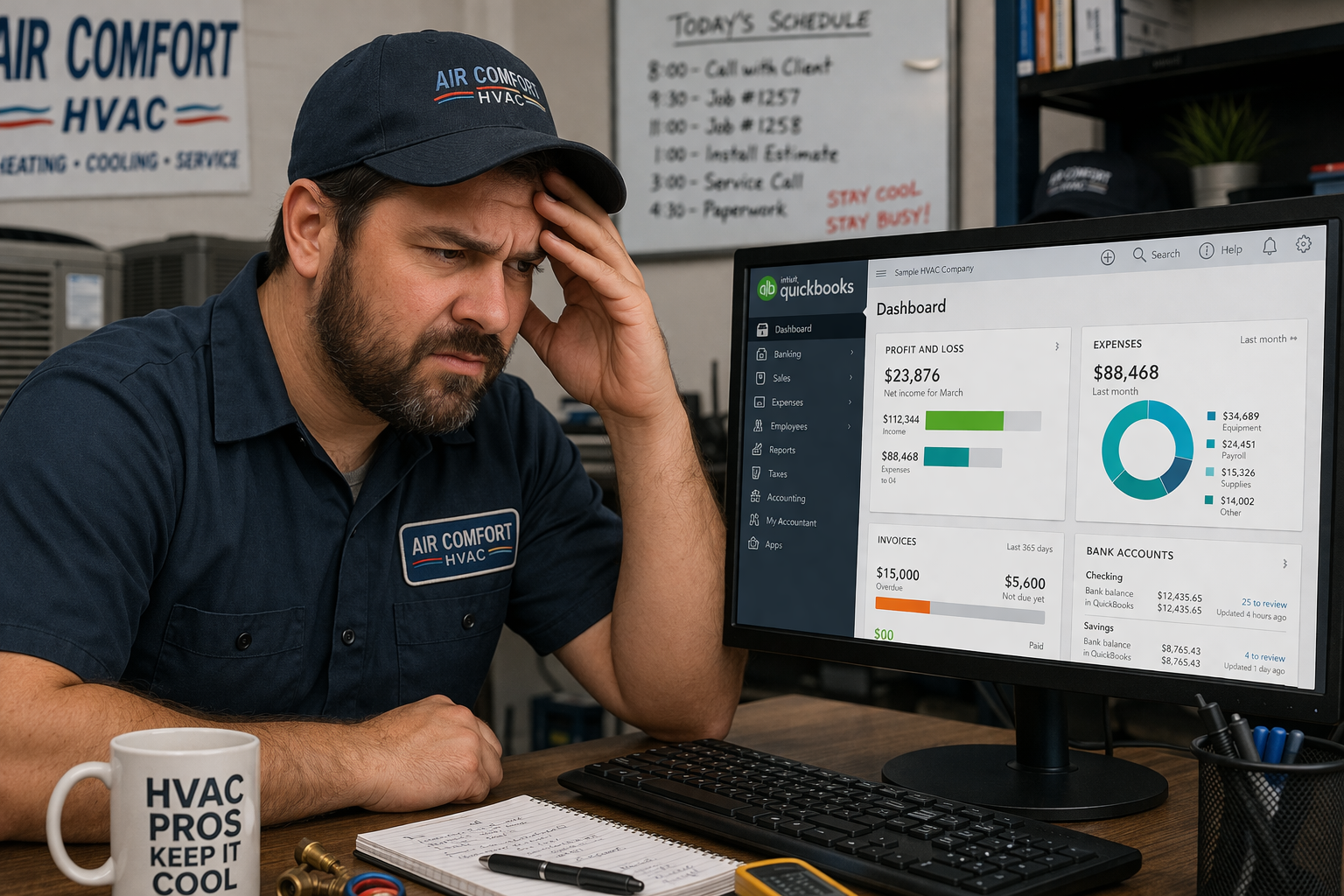
Running a successful HVAC business means far more than knowing how to install a heat pump or diagnose a failing compressor. Behind every thriving HVAC company — whether it's a solo technician or a crew of twenty — is a rock-solid financial foundation. Yet for most HVAC professionals, bookkeeping and accounting are the parts of the job nobody warned them about in trade school.
If you've ever found yourself drowning in invoices, confused by quarterly taxes, or unsure whether your business is actually profitable, you're not alone. HVAC bookkeeping is one of the most overlooked yet most critical aspects of running a sustainable heating and cooling business. This guide breaks down everything HVAC technicians need to know about bookkeeping and accounting services — and why getting your HVAC books right can be the difference between thriving and barely surviving.
Why HVAC Bookkeeping Is Different From Other Industries
Not all small business bookkeeping is created equal. The HVAC industry has a unique financial profile that sets it apart from retail stores, restaurants, or even other trades. Understanding these differences is the first step toward building smarter HVAC books.
Seasonal Revenue Swings
Heating and cooling demand is inherently cyclical. Summer and winter are boom seasons; spring and fall can run significantly slower. This creates dramatic cash flow fluctuations that generic bookkeeping advice simply doesn't account for. An experienced HVAC bookkeeper knows how to plan for lean months, build reserves during peak periods, and keep your business cash-flow positive year-round — not just when the phones are ringing off the hook.
Job-Based Costing
Unlike a retail business that sells uniform products at fixed margins, HVAC work is highly variable. A residential service call is very different from a commercial HVAC installation or a new construction project. Every job has different labor hours, material costs, equipment expenses, and overhead allocations. Proper HVAC bookkeeping requires job costing — tracking profitability at the individual job level so you know which types of work actually make you money.
Inventory and Equipment Management
HVAC technicians carry significant inventory — refrigerants, filters, capacitors, motors, thermostats, and more. Vehicles, tools, and specialized equipment represent major capital investments. Accurate HVAC books must account for inventory shrinkage, equipment depreciation, and vehicle expenses to give you a true picture of your bottom line.
Subcontractor and Employee Complexity
Many HVAC companies use a mix of W-2 employees and 1099 subcontractors. Managing payroll taxes, workers' compensation, overtime rules, and subcontractor payments adds layers of complexity that require knowledgeable HVAC bookkeeping to handle correctly and stay compliant with IRS rules.
The Core Components of HVAC Bookkeeping
Solid HVAC bookkeeping isn't one task — it's a system of interconnected financial practices that work together. Here's what a complete bookkeeping and accounting service for HVAC technicians should include.
1. Chart of Accounts Tailored to HVAC
Every bookkeeping system starts with a chart of accounts — the master list of categories used to record every financial transaction. A generic chart of accounts won't serve you well. Your HVAC books should include specific account categories for service revenue, installation revenue, maintenance contract revenue, refrigerant and materials costs, equipment purchases, vehicle expenses, subcontractor labor, payroll, tools, marketing, and licensing.
When your chart of accounts reflects the reality of your HVAC business, your financial reports become genuinely useful — not just tax documents, but decision-making tools that drive smarter pricing, hiring, and growth strategies.
2. Accounts Receivable Management
Cash flow problems kill HVAC businesses that are otherwise profitable on paper. Accounts receivable management is critical HVAC bookkeeping work. This means invoicing customers promptly after every job, tracking unpaid invoices, sending reminders on overdue accounts, and recording payments accurately. For HVAC companies working with property management firms or commercial clients, net-30 or net-60 payment terms are common — which means you could be out thousands of dollars in materials and labor before you see a check.
3. Accounts Payable and Vendor Management
Your HVAC books also need to track what you owe — to suppliers, distributors, equipment manufacturers, and subcontractors. Staying current on payables protects your supplier relationships and credit standing, while timing payments strategically can help smooth out cash flow during slow seasons.
4. Payroll Processing
If you have employees, payroll is one of the most compliance-sensitive parts of HVAC bookkeeping. Payroll must be processed accurately and on time, with proper withholding of federal and state income taxes, Social Security, Medicare, and any local taxes. Mistakes here lead to IRS penalties that can be steep and disruptive to your business. A professional HVAC bookkeeping service will also handle quarterly payroll tax filings (Form 941), annual W-2s and W-3s, and state unemployment tax reporting.
5. Job Costing and Profitability Analysis
This is where HVAC bookkeeping transforms from basic record-keeping into real business intelligence. Job costing means tracking the actual revenue and costs associated with each job — so you can see at the end of the month which types of work are your most profitable and which are bleeding money. Over time, detailed job costing in your HVAC books will reveal patterns that change how you bid, price, and market your services.
6. Bank Reconciliation
Every month, your HVAC books should be reconciled against your actual bank and credit card statements. This process catches errors, flags unauthorized transactions, and ensures your financial records reflect reality. Skipping bank reconciliation is one of the most common and costly bookkeeping mistakes HVAC technicians make when managing their own finances.
7. Monthly Financial Reporting
At minimum, your bookkeeping service should produce monthly financial reports including a Profit and Loss Statement, Balance Sheet, Cash Flow Statement, and Accounts Receivable Aging Report. These documents are the scorecard of your HVAC business. A bookkeeper who can help you understand and act on these numbers is invaluable.
HVAC Accounting: Tax Planning and Compliance
Bookkeeping is the day-to-day recording of transactions. Accounting takes that data and uses it for higher-level financial planning, reporting, and tax strategy. For HVAC technicians, tax compliance is a year-round concern — not just something to scramble over in April.
Quarterly Estimated Taxes
If you're self-employed or your business is structured as a sole proprietorship, partnership, or S-corporation, you're required to make quarterly estimated tax payments to the IRS. Missing these payments results in underpayment penalties. A good accounting service calculates your quarterly obligations based on your real-time HVAC books and ensures payments are made on time — every time.
Business Entity Structure
The legal structure of your HVAC business has major tax implications. Many HVAC technicians start as sole proprietors — which is simple but means you pay self-employment tax on all net profits. Forming an LLC taxed as an S-corporation can significantly reduce self-employment taxes once your business reaches a certain income level. A knowledgeable HVAC accountant can model the numbers for your specific situation before you make a change.
Key Tax Deductions for HVAC Technicians
One of the most valuable things an HVAC accountant does is ensure you're capturing every legitimate deduction. Clean, well-maintained HVAC books make documentation effortless at tax time. Here are the major deductions you should never miss:
- Vehicle expenses — Deduct actual vehicle costs (fuel, insurance, repairs, depreciation) or use the standard IRS mileage rate. For HVAC technicians driving service vehicles daily, this is often the largest single deduction available.
- Tools and equipment (Section 179) — You may be able to deduct the full cost of qualifying equipment in the year it's purchased rather than depreciating it over time, generating significant immediate tax savings.
- Home office deduction — If you operate from a home office, a portion of your mortgage or rent, utilities, and internet may be fully deductible.
- Continuing education and certifications — EPA 608 certification, NATE certifications, industry training, and trade publications are all deductible business expenses.
- Health insurance premiums — Self-employed HVAC business owners can often deduct 100% of health insurance premiums for themselves and their families.
- Retirement contributions — Contributions to a SEP-IRA or Solo 401(k) reduce your taxable income while building long-term financial security.
- Marketing and advertising costs — Your website, online ads, truck wraps, business cards, and sponsorships are fully deductible.
- Subcontractor costs — Payments to 1099 subcontractors are deductible, but must be properly documented to withstand IRS scrutiny.
Without accurate, up-to-date HVAC books, many of these deductions are difficult or impossible to substantiate during an audit. Clean bookkeeping is your first line of defense — and your biggest source of savings.
Common HVAC Bookkeeping Mistakes to Avoid
Even experienced HVAC business owners make financial errors that cost them money and peace of mind. Here are the most critical pitfalls to watch out for.
Mixing Personal and Business Finances
This is the number-one bookkeeping mistake among HVAC technicians: running personal expenses through the business account, or using personal accounts for business purchases. Commingled finances make HVAC bookkeeping a nightmare, create tax problems, and could expose you to personal liability. Open a dedicated business checking account and business credit card from day one — it's non-negotiable.
Falling Behind on Bookkeeping
It's easy to let your HVAC books slide during busy season when every day is packed with service calls and installs. But falling behind means you're flying blind. You don't know if you're actually making money. You don't know which customers owe you. You don't know if you can afford to hire another technician. Monthly — or even weekly — bookkeeping keeps you in control of your business, not the other way around.
Not Tracking Mileage
Vehicle expenses are enormous for HVAC businesses, and mileage is often the largest component. If you're not logging miles for every business trip, you're leaving significant tax deductions on the table. Use a mileage tracking app to automate this process — it takes seconds and can save you thousands each year.
Ignoring Cash Flow Until It's a Crisis
Profit and cash flow are not the same thing. An HVAC company can be profitable on paper and still run out of cash if receivables aren't collected promptly and expenses aren't timed carefully. Monitoring cash flow through your HVAC books on a regular basis prevents nasty surprises during slow seasons.
DIY Bookkeeping With No Accounting Knowledge
Many HVAC technicians try to manage their own books using QuickBooks or similar software without really understanding accounting principles. The result is often inaccurate records, missed deductions, and financial reports that don't tell the real story. Partnering with a professional HVAC bookkeeping service is almost always worth the cost — it pays for itself many times over.
Choosing the Right Bookkeeping and Accounting Service
Not every bookkeeper or accountant understands the HVAC industry. When evaluating bookkeeping and accounting services, look for these qualities:
Industry Experience
An accountant who works primarily with restaurants or retail stores won't have the same depth of knowledge about HVAC-specific issues — seasonal cash flow planning, equipment depreciation, job costing, refrigerant inventory tracking, and industry-specific tax deductions. Seek out professionals who specialize in serving HVAC contractors and home service businesses.
Cloud-Based Technology
Modern HVAC bookkeeping should be cloud-based, allowing you to access your financial data from anywhere — your truck, the job site, or home. Look for bookkeepers who work with accounting software compatible with HVAC field service platforms. Common integrations include QuickBooks Online, Xero, ServiceTitan, and Jobber.
Proactive Communication
The best bookkeeping services don't just send you reports — they help you understand what the numbers mean and what actions to take. Monthly financial reviews, tax planning conversations, and proactive alerts when something looks off are signs of a high-quality accounting partner.
The ROI of Professional HVAC Bookkeeping
Some HVAC business owners balk at the cost of professional bookkeeping, seeing it as an overhead expense rather than an investment. Consider the full picture:
- A professional bookkeeper may find enough overlooked tax deductions in your first year to pay for their fees several times over.
- Accurate job costing through well-maintained HVAC books often reveals that certain jobs, clients, or service types are unprofitable — allowing you to reprice or eliminate losing work.
- Clean, accurate financial records make it dramatically easier to secure business loans, lines of credit, or equipment financing when you need it.
- Time spent wrestling with your own books is time not spent on revenue-generating work or growing your business.
- Avoiding IRS penalties, late fees, and audit exposure alone can justify the investment many times over.
Getting Started: Your Action Plan
If your HVAC books are currently in disarray — or nonexistent — don't be discouraged. Here's a practical starting point to get your financial house in order:
Open dedicated business accounts
Separate business bank and credit card accounts from day one. This is the foundation of clean HVAC bookkeeping.
Choose accounting software
QuickBooks Online is the most popular for HVAC businesses and integrates widely with field service platforms like ServiceTitan and Jobber.
Catch up on historical transactions
A bookkeeper can help you reconcile past months or even years of records to bring your HVAC books current.
Set up an HVAC-tailored chart of accounts
Organize your books with categories that reflect your specific services, cost structure, and revenue streams.
Establish a monthly bookkeeping routine
Whether DIY with software and CPA review, or fully outsourced — consistency is everything in HVAC bookkeeping.
Schedule a tax planning meeting
Don't wait until April. Meet with an accountant before year-end to maximize deductions and avoid surprises.
Running an HVAC business is hard work. You've invested years developing technical expertise, building a reputation, and earning your customers' trust. Your HVAC books should reflect the true value of that work — and give you the financial clarity to keep growing. The right financial partner doesn't just keep the numbers tidy — they help you understand your business, reduce your tax burden, and build the kind of sustainable, profitable HVAC company you set out to create.


-1.png)